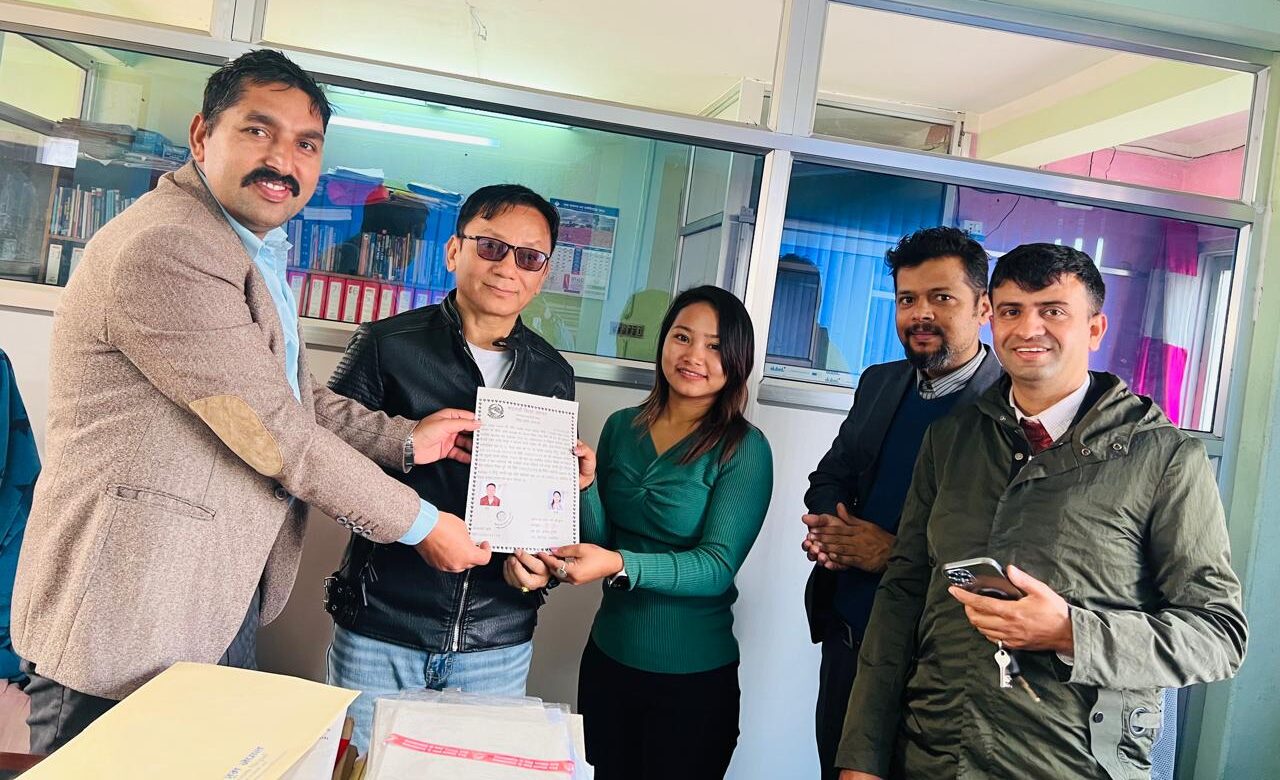
Nata Kayam (नाता कायम) means “establishment of relationship.” It is the official process of proving a family relationship — parent-child, husband-wife, siblings, or other kin — when your existing documents (citizenship, birth certificate, family records) don’t clearly show that connection on their own.
- Two ways to get it: the Ward Office (fast, for uncontested cases where everyone agrees) or the District Court (for disputed relationships or when records are missing).
- Governing law: National Civil Code, 2074 (2017) — mainly the provisions on parentage, birth registration, and kinship in Part 3, alongside the Local Government Operation Act, 2074 for ward authority.
- Typical ward timeline: 1–3 working days if your documents are in order.
- Typical court timeline: anywhere from a few months to over a year, depending on whether the relationship is contested and whether DNA testing is needed.
- Why people need it: citizenship (especially by descent), inheritance and property partition, land transfer at the Malpot (Land Revenue Office), pension and insurance claims, and NRN inheritance from abroad.
If you’re unsure which route applies to your situation, the safest first step is a short consultation — a mismatch between your citizenship certificate, birth certificate, or family details usually looks confusing to you but is a familiar pattern to a lawyer who handles it regularly.
What Exactly Is Nata Kayam?
In everyday life, your family relationships are just facts — you know who your parents are, who your siblings are, who you’re married to. But government offices, banks, and courts don’t take your word for it. They need it on paper, and that paper has to be internally consistent.
Problems show up when:
- A birth certificate was never issued, or was issued years after birth
- A name is spelled differently across a citizenship certificate, a land document, and a school certificate
- A father is deceased and never appeared on a child’s official documents
- Two documents disagree about a relationship (for example, a land record uses a maiden name while the citizenship certificate uses a married name)
- Someone disputes a relationship altogether — most commonly paternity
Nata Kayam is the legal mechanism that resolves this. It results in either a ward-issued relationship recommendation (often called Nata Pramanit or Parivarik Nata Pramanit Sifarish) or a District Court order, either of which becomes the official proof of the relationship that other government offices will accept.
The Legal Basis
Nata Kayam isn’t a separate standalone law — it’s built out of several pieces of legislation working together:
| Law | What it governs |
|---|---|
| National Civil Code, 2074 (2017) | The core rules on parentage, presumption of paternity, naming, birth registration, and how relationships are legally established or challenged |
| Local Government Operation Act, 2074 | Gives ward offices the authority to issue relationship recommendations (sifarish) |
| Civil Procedure Code, 2074 | Sets out how a disputed relationship case proceeds through the District Court |
| Citizenship Act, 2063 | The framework Nata Kayam most often feeds into, since citizenship — especially by descent — depends on provable parentage |
| Supreme Court directives on DNA evidence | The rules courts apply when ordering and interpreting DNA testing in disputed-paternity cases |
Court precedent has refined how these provisions apply in tricky real-world situations — disputed paternity after separation, inheritance claims among biological and adopted children, and posthumous relationship claims where a parent died before documentation was completed.
Route 1: The Ward Office (Uncontested Cases)
This is the route most people need, and it’s the simpler one.
When it applies: Everyone involved agrees on the relationship, and your documents are mostly consistent — just missing a formal link or containing a minor discrepancy the ward can resolve.
What you’ll typically need to bring:
- Citizenship certificates of the people whose relationship is being certified
- Birth certificate(s), where relevant
- Death certificate, if a relevant family member has passed away
- Family population/household registration card (Naagrik Janasankhya Patra)
- Recent passport-size photographs
- A written application to the ward office explaining the purpose
- Two to four local witnesses who can confirm the relationship, especially if ward records are incomplete
What happens: The ward office checks your documents against its own records, may briefly consult with your neighborhood or local representatives if something’s unclear, and then issues a signed, stamped recommendation confirming the relationship.
Timeline and cost: Often same-day to a few working days for straightforward cases; the ward fee itself is modest. Where witnesses or additional verification are needed, it can stretch to a week or more.
Route 2: The District Court (Contested or Complicated Cases)
When it applies:
- Someone disputes the relationship (most commonly a paternity dispute)
- Citizenship or birth records are missing entirely, and the ward can’t bridge the gap
- There’s an active inheritance dispute among multiple claimants
- The ward office has already declined to issue a recommendation
How it works:
- Filing the petition — filed at the District Court with jurisdiction over your residence, along with whatever documentation you already have.
- Notice to other parties — anyone who might dispute the claim is formally notified.
- Hearings and evidence — the court reviews documents and hears witness testimony, including from family members and, where relevant, ward officials.
- DNA testing (if needed) — see below.
- Final order — the court issues a binding determination of the relationship.
Timeline: Uncontested petitions with clear evidence can resolve in a few months. Genuinely contested cases — especially those involving DNA testing or multiple heirs — commonly take six months to well over a year.
When Is DNA Testing Involved?
DNA testing comes into play specifically in disputed paternity or contested biological-relationship cases where documents and witness testimony alone aren’t enough to settle the matter. Nepali courts apply Supreme Court directives that set out the procedure: both parties provide samples at an authorized laboratory, and the report is treated as expert evidence in the case.
A few important practical points:
- A confirmed match is generally treated as strong, often decisive, evidence of the relationship.
- A negative result typically defeats the claimed relationship.
- Refusing to take the test, when a party is clearly in a position to do so, is treated by courts as working against that party — the court can draw an unfavorable inference from the refusal.
DNA testing adds time and cost to a case, so lawyers generally reserve it for situations where the dispute genuinely can’t be resolved through documents and witnesses alone.
Why People Actually Need Nata Kayam: Downstream Uses
Nata Kayam is rarely the end goal itself — it’s the document that unlocks something else. The most common situations we see:
- Citizenship by descent — especially for children whose birth certificate is missing, delayed, or inconsistent with a parent’s citizenship record.
- Inheritance and property partition (अंश बण्डा) — before an estate can be divided, the heirs’ relationship to the deceased has to be formally established.
- Land transfer at the Malpot (Land Revenue Office) — when property passes by inheritance, the Land Revenue Office will not register the transfer without proof of the heir’s relationship to the previous owner.
- NRN inheritance claims — Non-Resident Nepalis inheriting property or assets from a relative in Nepal often need Nata Kayam to formally connect their foreign-held documents to the Nepali side of the family.
- Pension, provident fund, and insurance claims — survivors claiming a deceased family member’s benefits are frequently asked for relationship proof beyond a citizenship certificate.
- School enrollment and guardianship matters — particularly where custody has changed, or a child is being raised by someone other than a biological parent.
Documents Checklist
For the Ward Office route:
- Citizenship certificates (original + photocopy) of everyone involved
- Birth certificate(s), if applicable
- Death certificate, if a party is deceased
- Family population card
- Recent photographs
- Written application to the ward chair
- Local witnesses (2–4 recommended)
- Marriage certificate, if a spousal relationship is involved
For the District Court route, add:
- A formal written petition explaining the relationship and legal basis for the claim
- Any prior ward documents (including refusal letters, if applicable)
- Witness affidavits
- Court fee receipt
- Details of any opposing party who needs to be formally notified
If the Ward Office Declines Your Application
This happens more often than people expect — usually when records genuinely conflict or a family member disputes the relationship. Your options are:
- Gather more supporting documents or witnesses and reapply.
- Escalate within the local government structure (municipality-level review).
- File at the District Court, where a judge can weigh the evidence and issue a binding ruling.
Frequently Asked Questions
1. What does Nata Kayam mean? It literally translates to “establishment of relationship” — the legal process of officially confirming a family relationship where documentation alone isn’t sufficient.
2. Is Nata Kayam the same as a birth certificate? No. A birth certificate is issued at birth and usually shows parentage automatically. Nata Kayam becomes necessary when that document is missing, delayed, inconsistent, or disputed.
3. Can I go straight to the District Court, or must I try the Ward Office first? For an uncontested, well-documented relationship, the ward office is the faster and cheaper option and is where most people should start. The District Court is for genuinely disputed or under-documented cases, or where the ward has already declined.
4. How long does the Ward Office process take? Often just a few working days if your documents are complete and consistent. It can take longer if witnesses or additional verification are required.
5. How long does a District Court case take? It varies widely — straightforward, unopposed petitions may resolve within a few months, while contested cases, especially those requiring DNA testing or involving multiple heirs, can take well over a year.
6. When does a court order DNA testing? Only in genuinely disputed biological-relationship cases — most commonly paternity disputes — where documents and witness testimony aren’t enough to settle the question.
7. What happens if someone refuses to take a court-ordered DNA test? Courts can treat the refusal as evidence against the refusing party’s position, since it suggests they may be avoiding an unfavorable result.
8. Can I use Nata Kayam to help a child get Nepali citizenship by descent? Yes — this is one of the most common reasons families come to us. Where a parent’s or child’s documentation doesn’t clearly establish the parent-child relationship, Nata Kayam provides the official confirmation the Citizenship Office needs.
9. Do I need Nata Kayam to inherit property? Often yes, especially where there’s any ambiguity about your relationship to the deceased, or where multiple people are claiming a share of the estate. The Land Revenue Office will generally not process an inheritance-based property transfer without it.
10. I live abroad — can I complete Nata Kayam without returning to Nepal? In many cases, yes, with the right power of attorney authorizing a representative (often your lawyer) to act on your behalf in Nepal, and with your foreign documents properly authenticated for use in Nepal. This is common for NRN clients handling inheritance matters from overseas.
11. What if my family’s documents have name spelling inconsistencies? This is one of the most frequent issues we resolve — differences in spelling or transliteration across a citizenship certificate, land document, and school records can usually be reconciled with supporting affidavits and, where needed, a formal Nata Kayam application.
12. What if the relationship spans a missing generation — for example, a grandparent whose citizenship was never properly documented? These “broken chain” cases are common and solvable, but they typically require more documentation and witness support, and often need to go through the District Court rather than the ward.
How Nepal Legal Service Can Help
Nata Kayam cases are rarely just paperwork — they usually sit inside a larger family or property matter that actually matters to you: getting a child’s citizenship sorted, settling an inheritance, or transferring land that’s been stuck in limbo for years. Our team handles the process end to end:
- Reviewing your existing documents to identify exactly where the gap or inconsistency is
- Preparing and filing your Ward Office application, including witness coordination
- Representing you in District Court for contested or complex cases
- Guiding you through DNA testing procedures where necessary
- Connecting your Nata Kayam outcome to the next step — citizenship, inheritance, or property transfer — so you’re not left with a certificate and no clear path forward
- Assisting NRN clients from abroad through power of attorney arrangements
Get in touch for a consultation: 📍 Babarmahal, Kathmandu, Nepal 📞 +977 9851020168 (WhatsApp available) ✉️ info@nepallegalservice.com
Disclaimer: This article is provided for general informational purposes only and does not constitute legal advice. Every family situation is different, and outcomes depend on the specific facts and documentation involved. Please consult with our lawyers directly for advice on your particular case.